
It might seem obvious, but to increase the amount of soil organic matter (SOM) in the soil, the amount of SOM gained needs to be greater than the amount of SOM lost
Practices that increase the loss of SOM, such as tillage and over-grazing, should be reduced in favour of practices that increase the gain of SOM, such as careful rotational planning to increase species variety, the introduction of grass-leys, cover-cropping, and the addition of organic inputs.

An undersown cereal crop
Tillage
Tilling the soil adds oxygen and fractures the SOM that protects soil aggregates. This in turn gives SOM-decomposing bacteria more oxygen to thrive and more access to SOM – their food source. Tillage results in organic matter being quickly ‘burned’ by bacterial respiration, and so lost to the atmosphere as carbon dioxide.
The organic matter that is ‘burned’ first is typically the easy-to-digest glues that hold soil particles together in stable aggregates, so soil structure is quickly lost, leading to a chain of subsequent negative effects, such as greater soil erosion, harder workability, compaction, and reduced nutrient availability. All of these factors contribute to reduced crop growth and poorer overall soil health. In this context, reducing tillage as much as is feasibly possible is absolutely vital.
Cropping and Cover-cropping
The guiding principles to increasing SOM are to minimise loss and increase overall gain. By careful crop planning, we can reduce the amount of SOM lost and increase the amount of SOM gained. Using cover crops over winter and fallow periods is important as these will:
- Keep the soil cool (reducing SOM oxidation)
- Protect against erosion (losses of SOM to the environment)
- Increase the above-ground biomass and habitat for biodiversity (providing a supply of new organic material)
Good decision-making in cover cropping and cropping for production is also important, as the varieties chosen should vary in their rooting depth, rooting width, and rooting mass. A constant cropping rotation consisting of shallow and low-volume rooted crops greatly limits the amount of SOM captured, especially at greater soil depths, and should be avoided if the goal is to increase SOM.
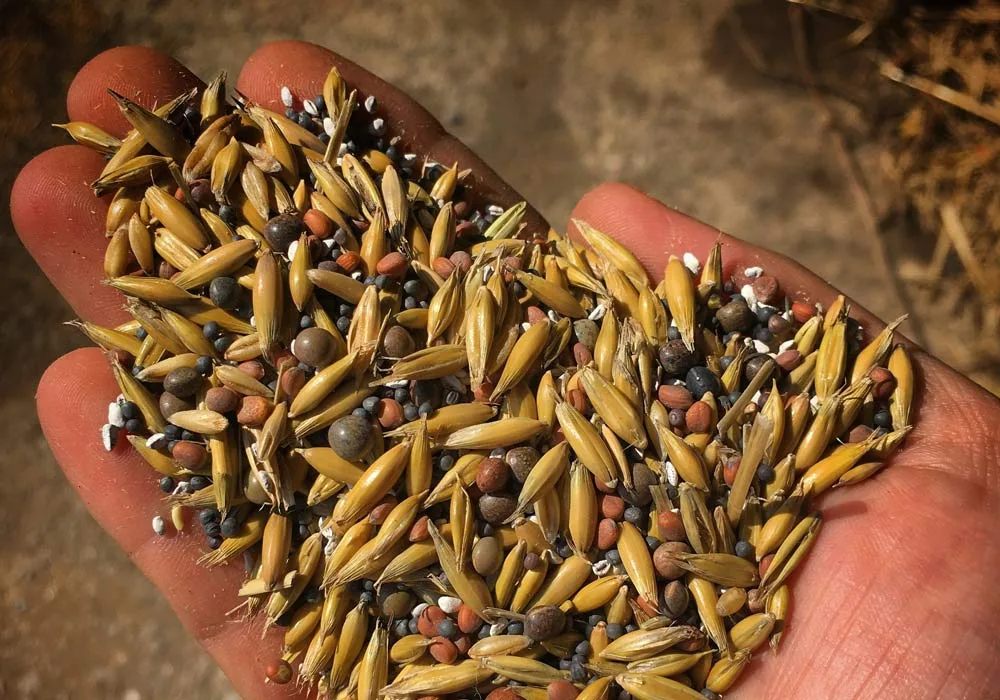
Cover crop mix
Organic Inputs
When it comes to increasing SOM, cover cropping and minimum-tillage practices will only go so far. While cover crops are an important practice, they are only in the ground for a portion of the year, with the rest being donated to food production crops that tend to have less rooting mass and supply less above-ground organic material. The supply of organic material to the soil should therefore be ‘topped-up’ with an applied source.
Straw is frequently incorporated from the food-production crop. However, straw is high in carbon and the soil biology will lock up nitrogen in the process of its decomposition. Having animals share the work of digesting the carbon-rich material prior to soil application, or employing a composting or fermentation method, will create a finer-textured organic material that, when applied to the soil, is far easier for the soil biology to digest and will cycle into stored SOM far more quickly.
Applications of manures and organic materials also bring in a wide range of nutrients that provide important food sources for soil biology and the next crop. However, care must be taken to avoid over-applying organic materials, as they can supply too much nutrition that could cause environmental pollution, as well as unwanted heavy metals and microplastics.
It is important to tailor organic matter management for each individual farm and field; what may work on one farm – or even field – may not necessarily work for another. Working with a Terrafarmer specialist will help you to identify what will work well on your farm and where work is needed most, ensuring that soil organic matter levels are managed as efficiently as possible – and to the best of your soil’s potential.
Get in touch
Our soil health assessment services, which can be combined with soil scanning and soil sampling, will give you the knowledge you need to improve your soils. Get in touch to find out more.


