
Terrafarmer’s Jack Pierce shares his first take on Minette Batters’ Farming Profitability Review—and why volatility, not efficiency, is the real profitability challenge.
A three-hour train journey gave me the chance to dig into Minette Batters’ newly published Farming Profitability Review: a detailed assessment of actions required to strengthen farming profitability.
At 155 pages, it doesn’t fully give itself up at train speed, so a proper cover-to-cover read is firmly pencilled in as Christmas reading.
Even so, a first pass makes one thing clear: much of what’s in the review reflects conversations the Terrafarmer team is already having every day with farmers, landowners, lenders, and supply chain partners. From an agribusiness perspective, it doesn’t feel radical—just long overdue.
Why this review, and why Minette Batters
The Farming Profitability Review was commissioned by Defra in 2025 after growing concern that, despite years of reform and transition, farming profitability in England continues to weaken.
The intention was to step back from individual schemes and policy tweaks and ask a more fundamental question: can farming be economically viable in its own right under the current system?
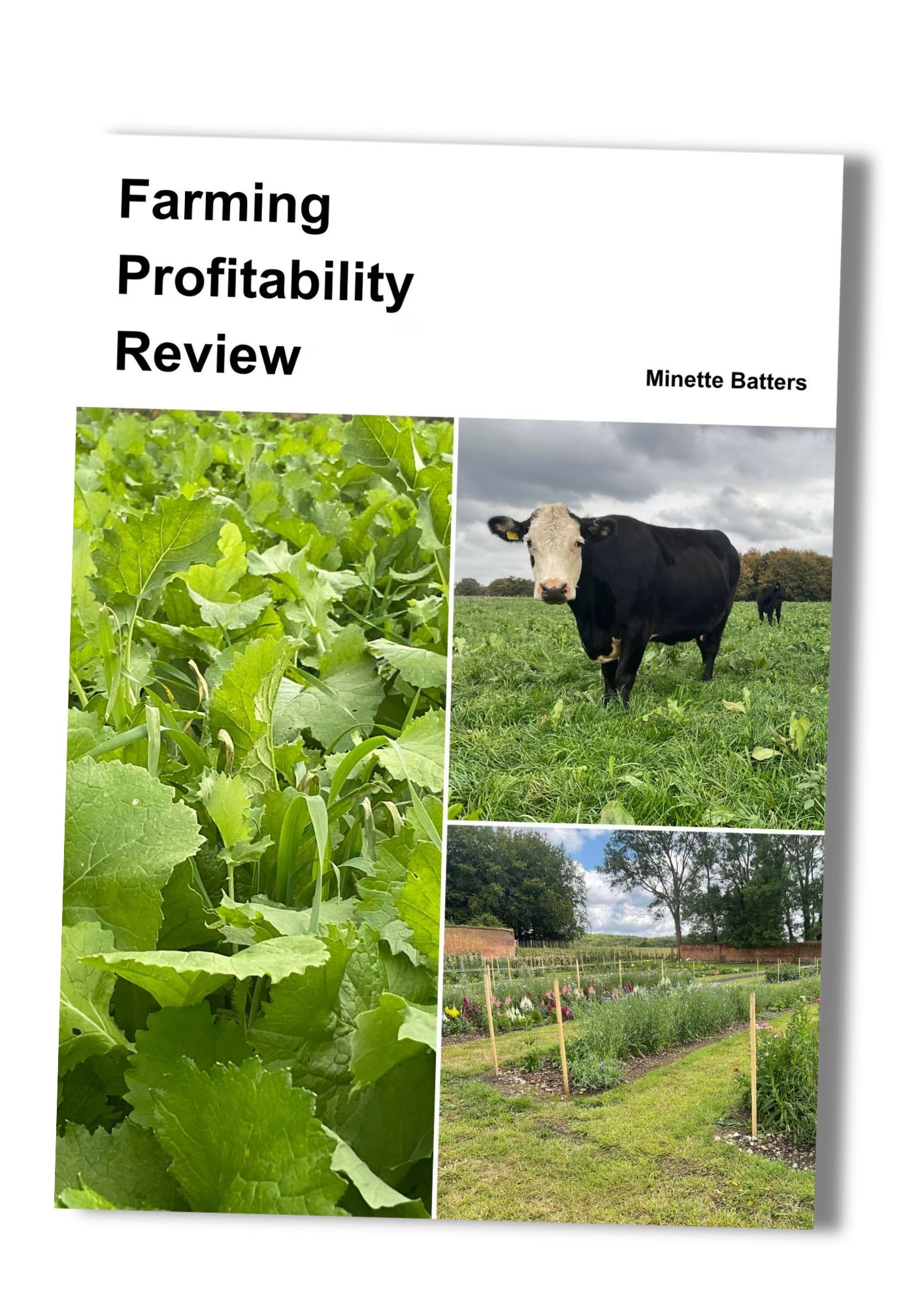
Minette Batters was asked to lead the review because she brings something many previous reviews have lacked: she is a working farmer (very close to home!) and a former President of the NFU, with first-hand experience of running a farming business and a deep understanding of how agricultural policy is made. The result is a document that feels commercially grounded and operationally realistic. It reflects a clear grasp of how farm businesses actually operate, and how policy decisions land on the ground.
The real issue isn’t efficiency. It’s volatility.
One of the strongest messages in the review is that farming’s profitability problem cannot simply be explained by poor management or lack of efficiency.
The data shows that even well-managed farms are regularly knocked off course by factors outside their control. Weather, input costs, labour availability, global markets, and frequent policy change all play a role.
As the Review puts it, “even farmers with good business management practices cannot escape … the impact of external events on their businesses.
From a consultancy point of view, this rings very true. We see businesses doing many of the right things: they benchmark, they manage inputs carefully, they plan ahead. Yet they still struggle to generate consistent returns from food production alone. Indeed, Batters highlights how hard it is to stay “top performing”. She notes that only 8% of farms stayed in the high-performance band over five years (2019/20–2023/24).
You can optimise a business, but you cannot optimise away structural uncertainty.
Why this matters beyond the farm gate
It is easy to frame this as solely a ‘farming issue’. It is not.
Farming underpins the entire agri-food system, from processors and manufacturers through to retailers, exporters and food service. When primary producers operate on wafer-thin margins, the knock-on effects are felt throughout the supply chain. Shorter contracts, under-investment, greater reliance on imports and reduced resilience when shocks occur all follow. From an agribusiness perspective, unprofitable producers are a long-term supply risk, not just a short-term pricing opportunity.

A more useful way to think about farming
One of the most valuable aspects of the review is how it reframes farming’s role in the economy. Batters recalls a recurring Whitehall response to the question of whether farming matters: “no, because it’s only 0.6% of GDP”.
The Review pushes back hard against that mindset by positioning food production as strategic national infrastructure. As it puts it, food is “part of our critical national infrastructure”. Food security, environmental delivery, rural employment and economic resilience all depend on it.
That matters because what we choose to value determines where investment flows, how policy is written and how supply chains behave. If farming is only ever viewed as a cost to be managed, declining profitability should not come as a surprise.
Supply chains and shared risk
The Review is frank about the imbalance of risk in many food supply chains. It is now widely accepted that farmers and growers often carry the greatest exposure, while having the least ability to pass risk on or respond quickly.
As the Review notes, “power imbalances exist in the supply chain… This leaves farmers with little leverage to negotiate fair returns.”
From a commercial standpoint, this is not just a fairness issue. It is a resilience issue.
Squeezing producers may improve margins elsewhere in the short term, but it undermines long-term supply capacity and confidence to invest in the changes we’re asking farms to deliver, including sustainability outcomes. After all, environmental delivery still depends on commercially viable farms.
Fairer contracts and greater transparency are not anti-market. They are essential if domestic supply chains are going to remain viable.
Nature, capital and where this is heading
The report’s focus on nature markets and frameworks, such as the Taskforce on Nature-related Financial Disclosures (TNFD), reflects the direction of travel we are already seeing from investors, lenders and corporates. The Review is explicit that government should mandate TNFD “to ensure a level playing field for all”.
In simple terms, businesses will increasingly be expected to understand how they depend on nature and how they impact it. That creates demand for credible environmental outcomes. Farmers are central to delivering those outcomes, but only if the markets are well-designed and accessible.
The key point here is that environmental income should support food production, not replace it. The Review itself stresses the principle of funding environmental benefits “over and above food production”. In other words, paying for additional outcomes delivered alongside profitable farming.
Done properly, public funding can significantly strengthen farm businesses, rather than distract from their core purpose. We see this in our funding consultancy work at Terrafarmer, where well-designed SFI and Countryside Stewardship options can support practical on-farm changes that improve resilience to climate change, alongside food production.
For taxpayers, it’s a sensible, win-win use of public funds: stronger farm resilience, more secure domestic production, and measurable environmental delivery.
The middle is where the opportunity lies
A key strength of the Review is its focus on mid-performing farms.
Most UK food does not come from the very top performers. It comes from businesses that are fundamentally sound but constrained by volatility, scale or access to capital and advice. The Review notes that the “middle 50%” account for 65% of agricultural output and 57% of all farms.
Helping the middle become more resilient would deliver far more impact than focusing only on ‘best-in-class’ examples and assuming the rest will simply consolidate or step aside. From where I sit, this is where targeted advice and clearer long-term signals can make the biggest difference—and deliver change at scale.
My takeaway
The Farming Profitability Review does not offer quick fixes, and that is probably its strength.
My initial takeaway, after a skim on the train rather than a deep dive, is that profitable farming depends on certainty, not perfection: clear direction, fairer risk sharing, and a system that recognises the full value of what farms produce, whether that is food, environmental outcomes or resilience.
The challenge now is turning this analysis into action. Without a profitable farming base, the rest of the agri-food system becomes harder, more fragile and ultimately more expensive to sustain.
For farm and rural businesses, it is crucial to understand the financial performance and sensitivity of each individual farm enterprise in order to plan effectively. Increasingly, there needs to be a stronger emphasis on margin rather than yield, while also tapping into emerging natural capital markets where appropriate.
If you want to sense-check where profitability and volatility risk sit in your own business, Terrafarmer can help. We work with farm businesses to understand enterprise margins, stress-test volatility, and turn funding and investment options into a practical plan.

About the author
Jack specialises in helping farms through the agricultural transition and unlocking grant funding opportunities, with a particular interest in using innovative technology and practices to increase productivity and performance. He is a committee member of the Wiltshire Royal Agricultural Benevolent Institution charity.


