Terrafarmer is providing the South East Rivers Trust with a detailed soil carbon baseline to support regenerative land management
The South East Rivers Trust (SERT) is dedicated to improving the health and resilience of river catchments across south-east England. As part of their environmental strategy, SERT sought to establish a soil carbon baseline across eight holdings (covering just over 1,700 hectares) managed by farmers in the Eden Valley Farm Cluster to assess soil carbon levels and inform land management decisions that enhance carbon sequestration and soil health.

Buggy taking a soil sample in a field to establish a Soil Carbon Baseline for South East Rivers Trust
To deliver this project, SERT partnered with Terrafarmer, the soil health and regenerative farming consultancy, to design and implement a rigorous soil sampling and carbon assessment programme. The project is being jointly funded by SES Water and Bore Place, a 500-acre regeneratively managed historic estate situated in an Area of Outstanding Natural Beauty near Sevenoaks in Kent.
SES Water and Bore Place have been working together over recent years to improve land management to boost outcomes for nature and the public in the local area. This collaboration has now been formally funded through the Farming in Protected Landscapes (FiPL), a government-funded grant programme for farmers and land managers in National Parks and Areas of Outstanding Natural Beauty.
Project Objectives
- Accurately measure soil organic carbon (SOC) stocks across 1,700 ha.
- Develop a robust, data-driven soil sampling methodology for maximum precision.
- Support long-term soil health monitoring and carbon sequestration strategies.
- Provide actionable insights for farmers and landowners to optimise soil management practices.

A member of the Terrafarmer team taking soils samples for the South East Rivers Trust
Our Approach
Developing a High-Precision Soil Sampling Methodology
Working alongside Loamin, an expert in soil carbon monitoring, Terrafarmer employed a stratified random sampling approach. This provided:
- Remote sensing, topographic, soil, and climate data to identify key sampling zones.
- Geospatial modelling and machine learning to optimise sampling locations.
- High-precision GPS soil sampling to ensure accurate and repeatable results.
By dividing the landscape into zones with similar soil carbon characteristics, this method reduced variability and improved the accuracy of soil carbon measurements compared to a traditional grid sampling approach.
Field Sampling and Laboratory Analysis
Once the sampling methodology was finalised, Terrafarmer’s logistics team worked directly with the eight farms to carry out soil extractions:
- Soil sample points were carefully selected across the 1,700 ha area.
- Soil cores (0-30 cm depth) were extracted and logged with precise GPS coordinates.
- DUMAS combustion analysis was used to determine organic carbon content, ensuring the highest accuracy and international comparability.
This approach ensured data integrity and repeatability, enabling long-term re-sampling to track changes in soil carbon over time.
Data Reporting and Next Steps
All collected data was delivered to SERT in a structured .CSV format, along with detailed soil carbon maps. These outputs provide a scientifically rigorous baseline for ongoing soil carbon monitoring and regenerative land management planning. The partnership used Senus software for soil sampling and mapping.
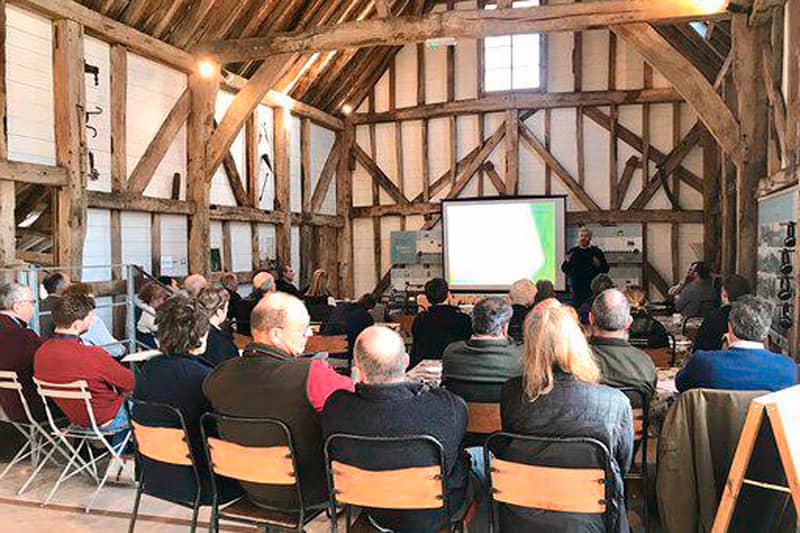
Terrafarmer can also offer farmers and landowners additional support, such as in-person farmer workshops covering soil health, carbon farming, nutrient use efficiency, and regenerative farming practices, as well as an overview of the potential opportunities for monetary compensation for regenerative management practices in the carbon credit market.
Looking to the Future
By establishing a soil carbon baseline, SERT is taking a proactive approach to enhancing soil resilience, improving land management, and increasing carbon sequestration potential. This project lays the foundation for the adoption of future regenerative practices, helping farmers and landowners adopt climate-positive farming strategies that benefit both agricultural productivity and environmental sustainability.
Interested?
Following the success of this project, Terrafarmer is keen to continue working with organisations like SERT to scale up regenerative agriculture solutions. Our focus remains on data-driven, farmer-first approaches that empower farmers and landowners to manage their soils in ways that are productive, sustainable, and climate-resilient.
If you are interested in soil carbon baselining, regenerative farm planning, or exploring carbon market opportunities, please get in touch with the Terrafarmer team today.
Tags: